
Sky Report July 6 – July 12
Summer is definitely here, and so is the summer Milky Way. Most people who live in the United States never see it except when on vacation in dark areas, but some of us lucky ones see it nightly. This month it arcs across the eastern sky as darkness falls, but it rises higher as the hours pass. The brightest part of the Milky Way is in the direction of the constellation Sagittarius which is due south at midnight, and that’s the direction toward the center of the Milky Way which lies some 26,000 light years from earth. Explore the Milky Way with binoculars.
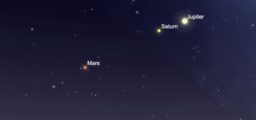
The planets Jupiter and Saturn rise together at 10 PM, Saturn following brighter Jupiter. They’re at their highest at 2 AM, and both are in Sagittarius.
Mars joins them at 1 AM and it’s high in the southeast at sunrise. Note Mars’ pale orange or red color which is due to oxidized iron – rust – on its surface. Mars is slowly brightening as the earth approaches it. The third-quarter moon is near Mars on the morning of the 11th.
Mars is in the constellation Cetus, the Whale, this week and the next two. Cetus is not one of the 12 traditional constellations of the zodiac, but according to the way modern astronomers divide the sky into 88 official constellations, Mars cuts across a corner of Cetus from the 8th through the 26th, reentering Pisces on the 27th.
Last but far from least, Venus rises at 4 AM, while the sky is still fully dark. By 5 AM it should be high enough to see it, depending on your local horizon, and you can follow it until well after sunrise if you know where to look. Telescopically, Venus is a thin crescent. Venus is in front of the nearby cluster of stars called the Hyades, in Taurus, which makes a nice sight in binoculars while the sky is still dark. On the few mornings around the 11th Venus is especially close to the star Aldebaran, the fiery orange eye of the Bull.
There’s a possibility that a recently discovered comet will become bright enough to see in binoculars this week only. Named C/2020 F3 NEOWISE, it will be very close to the northeast horizon in morning twilight. You’ll find current observing information and maps at heavens-above.com; be sure to set your location and the date.
The Sky Report is presented as a public service by the Stellar Vista Observatory, a nonprofit organization based in Kanab, Utah, which provides opportunities for people to observe, appreciate, and comprehend our starry night sky. Additional information is at www.stellarvistaobservatory.org. Send questions and comments to
John@StargazingAdventures.org.


Comments are closed.