
Sky Report: February 7 – 14

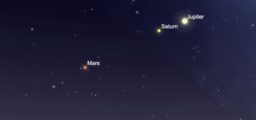
All last autumn you could see brilliant Venus, very bright Jupiter, and bright Saturn, all lined up in the southwest in the evening sky. Now we’re down to Jupiter, and we lose it too this week. On the 7th it is 9° high 45 minutes after sunset and you’ll see it if nothing blocks your view, but on the 13th it’s 5° high 45 min after sunset, so say good-by to Jupiter as it slips behind the sun.
To compensate, Venus has become the brilliant “morning star” that rises in the southeast 2½ hours before the sun and is well up in the sky during morning twilight. The sun rises late in February so you don’t have to rise yourself especially early to see it.
Both Mars and Mercury are near Venus, but they’re much fainter. Mars is about 7° to the lower right of Venus and Mercury is about twice as far to the lower left. All three planets are in the summer constellation Sagittarius. Sagittarius seems out of place in February’s cold sky, but with February’s long nights you can see more than half the sky between sunset and sunrise.
An excellent star chart that includes the planets is at Heavens-Above.com; customize for your location and go to “Interactive Star Chart”.
The moon passes near some interesting objects this week. On the 7th the planet Uranus is 5 moon-diameters (2½°) to the right of the moon and you can see both together in binoculars. Uranus is a bit too faint to see without at least binoculars, but if you never have seen it, this is a good chance to spot it. Uranus has a slight greenish hue when seen through a telescope and that may help you identify it.
On the 9th the moon is roughly midway between the Pleiades and Hyades Star Clusters in Taurus. The Hyades is to the lower left and the Pleiades to the lower right. All the stars in a cluster were born together and are the same age; for the Hyades they are about 600 million years old and the Pleiades about 90 million years old — the same age as the Rocky Mountains. Stars within a cluster are different brightnesses because of their mass – stars born heavy shine brighter (and burn out sooner). The Pleiades looks smaller partly because it is three times as distant, 420 vs. 150 light years.
Thanks to a 2021 grant from the Utah Governor’s Office of Economic Development and the Kane County Office of Tourism, Stellar Vista Observatory offers portable telescopes and tripod mounted binocular kits on loan for free to all residents of Kane County. Nothing beats a quality binocular or astronomical telescope to enhance enjoyment of the night sky! Visit https://stellarvistaobservatory.org/discover-the-night-sky/ or Kanab City Library for full details.
The Sky Report is presented as a public service by the Stellar Vista Observatory, a nonprofit organization based in Kanab, Utah, which provides opportunities for people to observe, appreciate, and comprehend our starry night sky. Additional information is at www.stellarvistaobservatory.org. Send questions and comments to John@StargazingAdventures.org.


Comments are closed.